

A portfolio that gets out of the way of the work.
Samuel N. Gilbert reports on the American West — social, environmental, and food justice across immigration, borderlands, climate, and Indigenous food systems. His bylines run from The Guardian and The Washington Post to Al Jazeera, Vice, Outside, Civil Eats, The Daily Beast, and a dozen others. His old WordPress setup was getting in the way. The new site does not.
Who Samuel is.
A working journalist whose beat ranges from Ramallah to Santa Fe. He started freelancing at a small Palestinian newspaper, went through the investigative program at Columbia’s Journalism School, returned to New Mexico in 2015, and has been filing on social, environmental, and food justice in the American West ever since. Seventeen outlets carry his work — The Guardian, The Washington Post, Al Jazeera, Vice, Outside, Civil Eats, The Daily Beast, Motherboard, The Santa Fe New Mexican, Source New Mexico, New Mexico Magazine, Palestine Chronicle, Counter Punch, Truth Out, Narratively, Wyoming Truth, Youth Today.
The brief.
Samuel had a WordPress site. It worked, in the sense that it loaded. It did not work for what Samuel needed: it took time he should have spent reporting. For his particular setup it meant plugins to update, themes to wrestle with, and a back office that demanded a passing familiarity with a content management system to do the most basic edit.
WordPress is a fine tool for plenty of shapes of work. For Samuel’s, it was the wrong fit. The wrong fit taxes the person it’s supposed to serve — that’s true of any tool in any category, which is also the whole story of why we don’t pick a stack before we understand the work.
What we built.
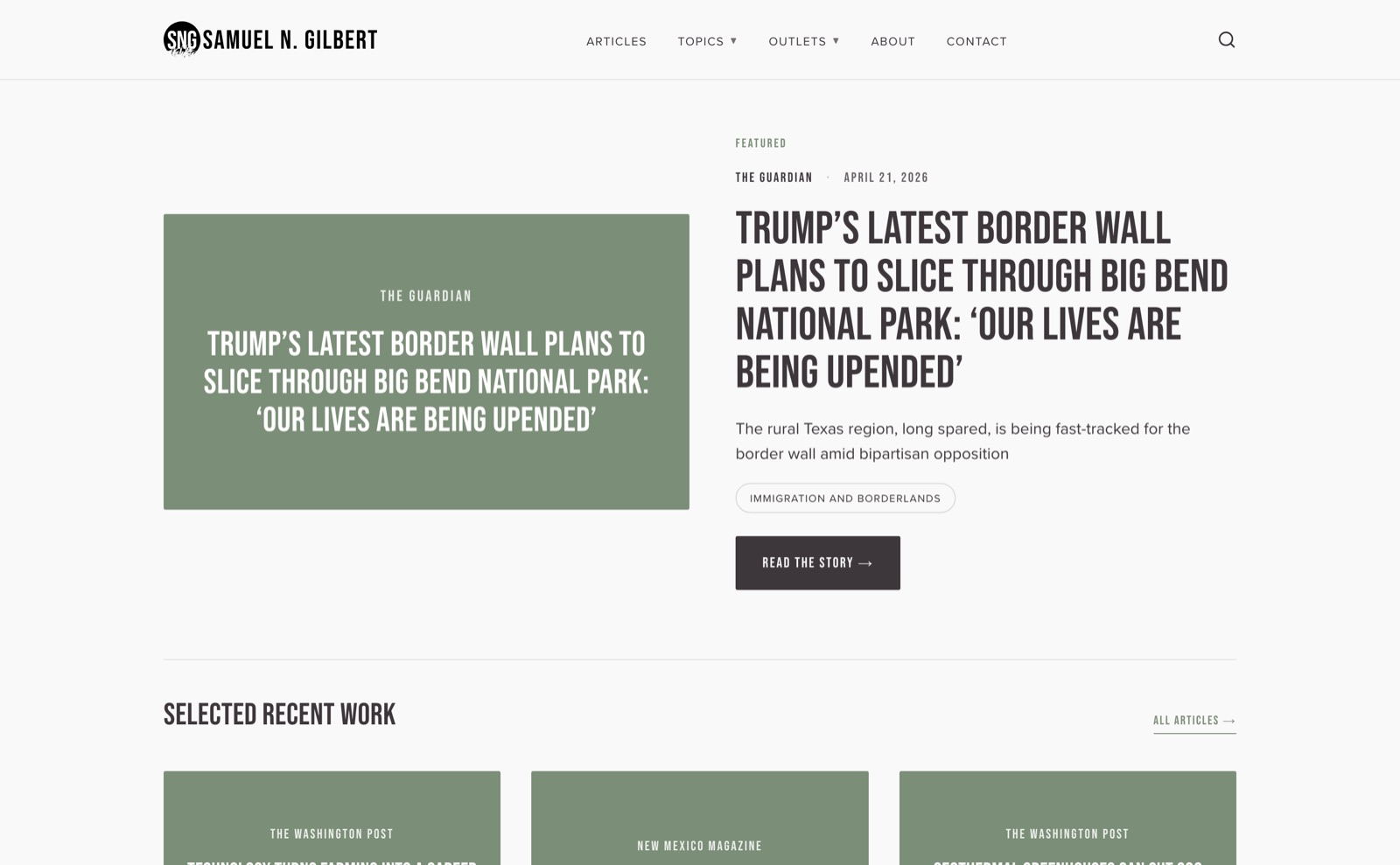
A portfolio that publishes the work, shows the outlets, surfaces the beats, and stays out of Samuel’s way.
The site organizes ninety-eight in-depth pieces across six topic clusters — immigration and borderlands, Palestine and Israel, farming and climate change, environment, Indigenous foodways, plus the in-depth catch-all. Seventeen outlets are aggregated, from The Guardian (with thirty pieces) down to single-placement venues. Each article carries its outlet attribution, topic tags, and publication date. Readers and editors can filter either axis.
RSS is auto-generated so existing subscribers keep getting his work without anyone moving. Search runs across the full catalogue. The About panel says who he is in a paragraph. Nothing else gets in the way.
How it shows up.
Open the homepage and the lede article is whatever Samuel surfaces — currently a Big Bend reporting piece for The Overview. Click an outlet tag and you see every piece in that outlet. Click a topic and the same. The featured-article hero anchors the page; the recent-work grid carries the rest. No hero animation. No scroll-jacking. The reader’s attention is the deliverable.
What changed.
Samuel writes. The site reflects what he writes. Behind the editorial polish there is no plugin economy to maintain, no theme that breaks on the next update, no platform to relearn. The codebase, the content, and the credentials are his to operate, extend, and build on.
The site does the job. He spends his time reporting.
A note on craft.
The site is deliberately text-forward. Journalism doesn’t need decoration; it needs the right typography, the right hierarchy, fast loads, and a layout that respects the reader’s attention. The design serves the work.
That’s the rule we’d apply to your engagement too: not everyone needs to be a web developer. Not every site needs to perform being a website. The right tool is the one that fits the work — and the person doing it.
If this is your shape, that’s what we do.
Curious if we're a fit?
Thirty minutes, no deck. We listen first.